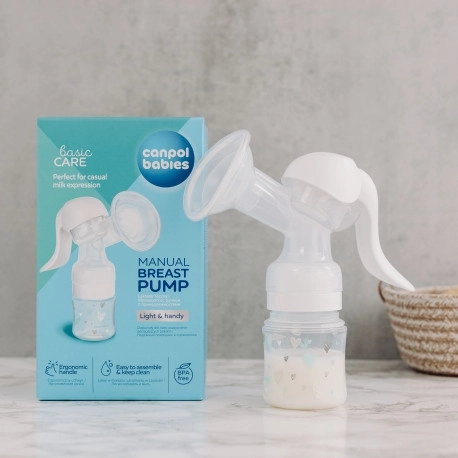
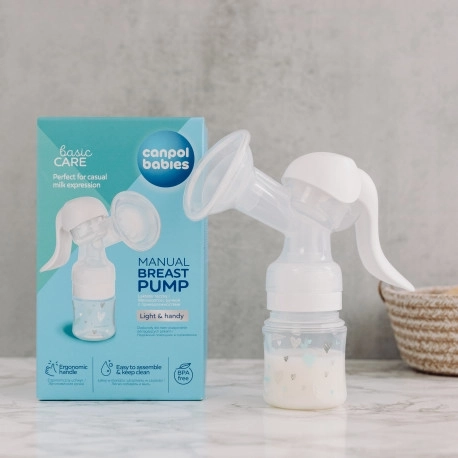
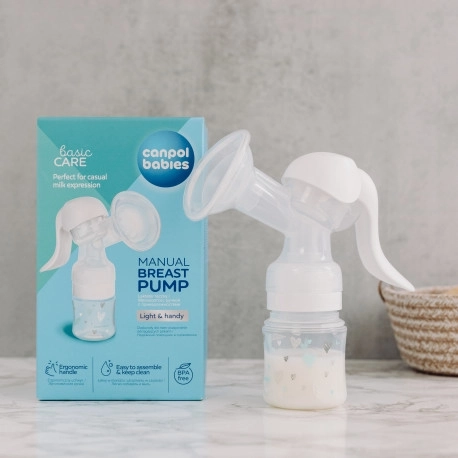
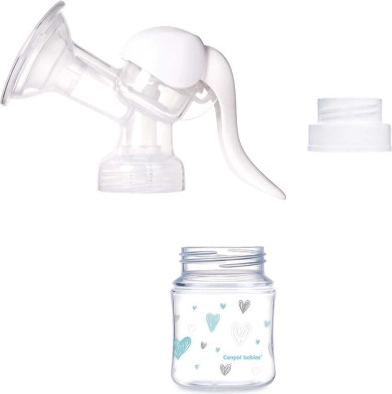
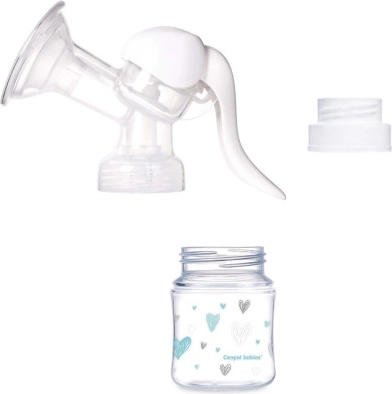
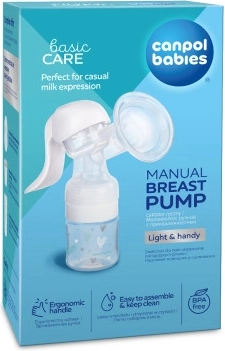
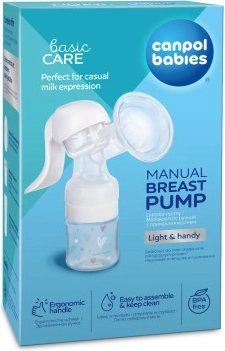
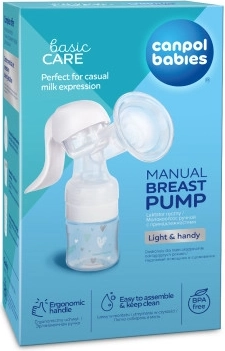
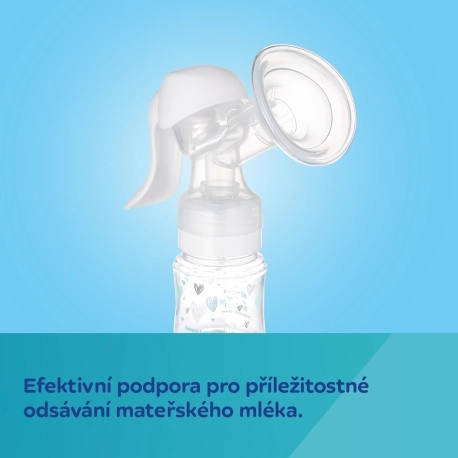
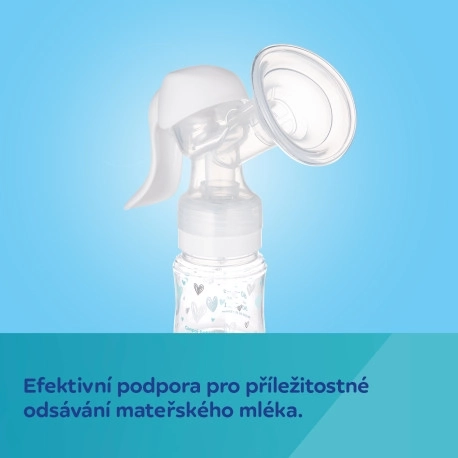
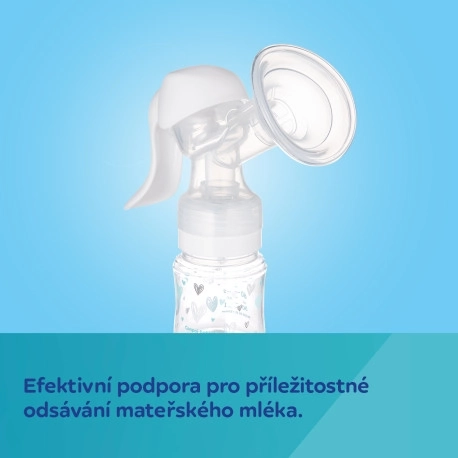
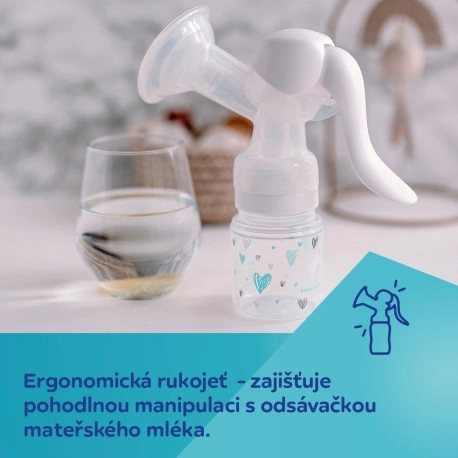
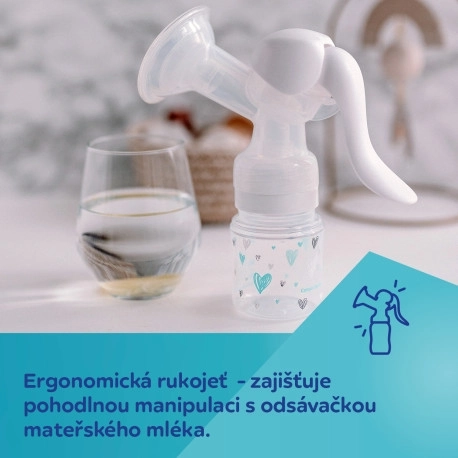
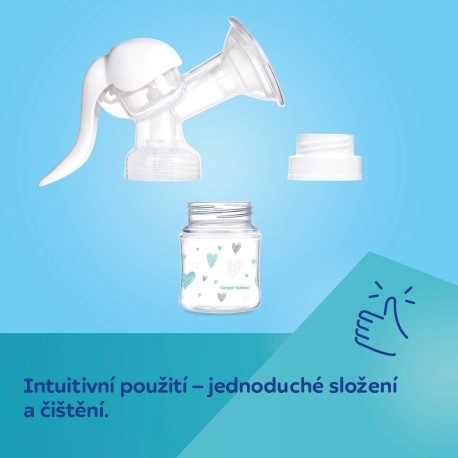
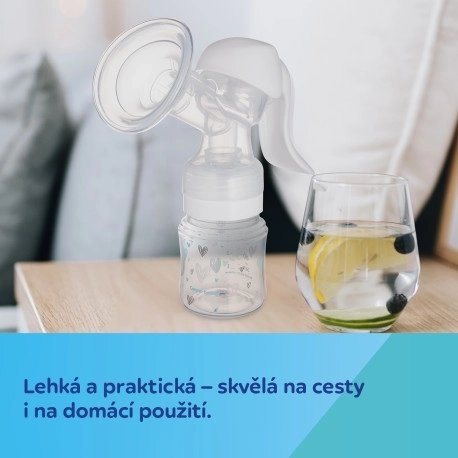
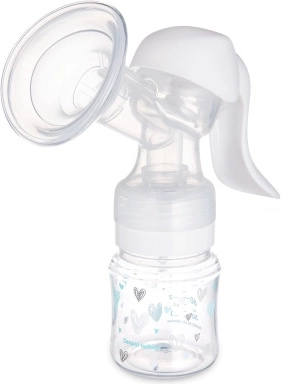
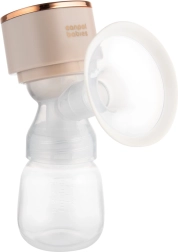
The Basic manual breast pump is easy to use and maintain. The small number of parts makes cleaning simple. A specially shaped lever makes pumping very comfortable and does not require much force. A practical base ensures the pump stands stably. The shaped funnel perfectly follows the shape of the breast. The silicone massaging breast insert gently massages and, by expressing excess milk, helps prevent inflammation. It is compatible with other milk storage accessories – you can pump directly into classic bottles and wide‑neck Canpol babies bottles. The manual breast pump is suitable for all Canpol babies baby bottles with wide and narrow necks thanks to the included adapter. The set includes: breast pump body with funnel and cover, 120 ml wide‑neck bottle with 3 m+ teat, and a bottle adapter. Effective support for occasional milk expression. Ergonomic handle – allows a comfortable grip while pumping. The shaped funnel ensures a tight fit to the breast. The silicone funnel provides gentle and efficient expression. Very easy to use – simple to assemble and clean. Lightweight and practical – ideal for home and travel. Compatible with all Canpol babies bottles. Made from safe, BPA‑free material.
When should you use a breast pump? If possible, wait 2–4 weeks after birth before using a pump, until lactation stabilizes. Exceptions to this rule: If you have too much milk and your breasts are engorged and hard. Expressing some milk before or during feeding relieves engorgement and helps the baby latch. The nipple is drawn into the breast due to a long break between feeds. You have inverted, flat, or sore nipples (pumping helps shape inverted or flat nipples). You feel sudden engorgement between feeds and do not want to wake the baby. The baby is ill and cannot suck. In case of low milk supply – using a pump stimulates the mammary glands. If you return to work and do not want to stop breastfeeding – use a pump to simulate the natural feeding process.
How often should you pump? If the mother cannot breastfeed, we recommend pumping 8 times a day. This keeps lactation at the proper level. At first you may have trouble expressing larger amounts of milk, but after a few days there will be more. With stabilized lactation, a single pumping session usually yields 30–60 ml, so you may need several sessions to obtain one feeding portion.
How to clean and sterilize the pump? Before first and each subsequent use, disassemble the pump into individual parts. Wash all pump parts and the bottle/container thoroughly in warm water with a mild detergent, rinse well, and sterilize according to the instructions below. For hygiene, before first use sterilize all pump parts and the bottle/container in boiling water for 5 minutes. Before each subsequent use, for hygiene, sterilize all pump parts and the bottle/container by pouring boiling water over them or in a steam sterilizer. Warning! After sterilization, wait until all parts have cooled. Do not assemble while parts are warm or damp, as the pump may not work properly.
How to clean and sterilize the teat? Before first and each subsequent use, wash the teat in warm water with a mild detergent, rinse thoroughly and sterilize in boiling water for 5 minutes. Do not leave the teat in direct sunlight or near a heat source, and do not leave it longer than recommended in disinfectants – this may weaken it. Do not use any chemical disinfectants. Before each use, check the teat carefully, especially once your child has teeth. Pull the teat in all directions. At the first signs of damage or material wear, replace it. Do not overtighten the screw ring, as the teat cannot vent properly. For safety and hygiene, we recommend replacing the teat at most every 3 months.
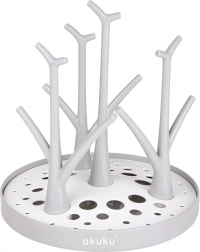
HOW TO PROPERLY PUMP WITH THE BASIC PUMP? Wash your hands thoroughly before pumping and ensure the pump is washed and sterilized (remember parts must not be warm or damp during assembly) and assembled as instructed above. Check the correct fitting and tightness of all parts. For effective expression, pump between feeds, not immediately after feeding. Before pumping, place a warm towel on the breast to encourage milk flow. Sit comfortably. Do not pump if you are stressed or tired, as this can inhibit let‑down. Place the pump on the breast and make sure the silicone massaging insert fits tightly. Any air leak impairs expression and the lever may not return to its original position. Do not remove the silicone massaging insert, which stimulates milk flow. A vacuum must form to ensure proper pumping. If you want milk to flow faster, lean forward slightly but keep the bottle vertical. Always keep the bottle upright so the milk can flow to the bottom. At first, pump from each breast for only a few minutes. Do not expect a full bottle immediately. Over time the amount expressed will increase. If milk stops flowing, switch to the other breast. Remember that expressing 60/120 ml takes about 10 minutes. The amount expressed in the same time can vary significantly. After finishing, unscrew the pump body from the bottle, disassemble, and wash all parts in warm water with a mild detergent and rinse thoroughly. Dry on a clean towel or a drying rack.
How to store expressed milk? You can store expressed milk in the bottle or in special food storage containers. Freeze only freshly expressed milk. Never fill the bottle to the top to allow for expansion when freezing. Thaw frozen milk slowly in a natural way like other foods; never use a microwave. This can change the structure of the milk and destroy valuable nutrients. You can thaw milk overnight in the refrigerator and then warm it in a bottle warmer or hot water. Shake the milk to mix the separated fat. Use thawed milk within 24 hours. Keep it refrigerated during this time. Never refreeze thawed milk. Never mix freshly expressed milk with thawed milk. Never boil or microwave frozen milk. Always check the temperature before feeding. Do not reuse leftover thawed milk.
Freshly expressed milk / Thawed milk storage guidance: Room temperature – freshly expressed: up to 12 h; thawed: do not store. Refrigerator (+4°C) – freshly expressed: 2–5 days; thawed: 24 h. Freezer compartment of refrigerator (–10°C) – freshly expressed: 2 weeks; thawed milk must never be refrozen. Deep freeze (–18°C to –20°C) – freshly expressed: 6 months; thawed milk must never be refrozen.
IMPORTANT! · The pump must not be used for purposes other than those described in the instructions. · Keep the product away from heat sources and open flames. · Before use, check that all parts are assembled correctly. · If you feel discomfort in your breasts during pumping, stop using the pump immediately. · Wash your hands thoroughly before each use. · Keep out of reach of children. · Protect the product from impact and drops. · Do not touch boiled parts with bare hands.
The pump complies with: Regulation (EC) No 1935/2004 of the European Parliament and of the Council – general requirements for materials and articles intended to come into contact with food. Commission Regulation (EU) No 10/2011 on plastic materials and articles intended to come into contact with food.