
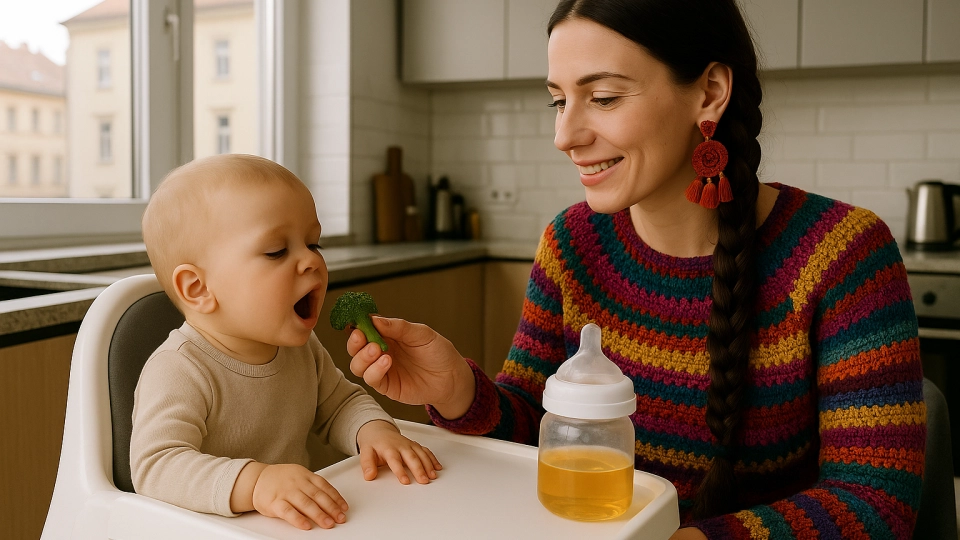
Is your reality a carefully prepared purée that ends up everywhere but your baby's tummy? Refusing solids and new foods is a very common problem that most parents go through. If a child refuses to taste anything new, it is often linked to parents' concerns about their child's satiety and health.
Children most often begin to refuse solids or new foods around 6 months of age, and sometimes this period lasts until the age of two or three. Up to 40% of children in this age group experience a period of food neophobia, meaning fear of new foods.
It is important to mention that refusing food and solids does not necessarily mean medical or psychological problems; sometimes it is simply a developmental phase that will pass with time. Every child develops at their own pace, and as parents you can try many things to make this phase easier.
When and why do children refuse solids and new foods?
Babies are born with a natural preference for sweet and mild flavors — breast milk, their first food, is sweet and tasty. By introducing solids, a baby enters a completely new world of tastes, smells, and textures, which can trigger fear and refusal. This is called food neophobia and is a natural safeguard against ingesting something potentially dangerous.
Physiological reasons for refusing solids can include teething with sore gums, fatigue, reflux, or nausea. Some children may be more sensitive and respond with refusal to new textures or intense flavors. In any case, consult your pediatrician to make sure there are no more serious health issues behind the refusal.
Psychological aspects include, above all, the child's need for autonomy. Between 1–3 years of age, children have an increased need to control their world; by refusing food they demonstrate their will and autonomy. Habit also plays a role. Children often reject novelties because they feel safer in a familiar environment.
The most common mistakes parents make when introducing solids
One of the most common mistakes is introducing new foods too quickly. A child needs time to learn to consume a new type of food. It often takes 10–15 exposures for a child to get used to it.
Many parents also put emphasis on the amount of food eaten, which ultimately causes stress for both the child and the parent. Another mistake is creating unfortunate conditions, such as watching TV during feeding, to make the child "eat better". While this strategy may bring short-term relief, in the long run you build unhealthy habits and a dependence on distractions.
A big problem is focusing too much on what the child eats. Children are sensitive to parental emotions, and the more emotionally charged the situation is, the more the child refuses food.
How to proceed correctly
It is generally recommended to start introducing solids at around 6 months of age, gradually and slowly. Start with single-ingredient vegetables and only gradually move on to other ingredients.
As a general recommendation, complementary foods should be prepared without added sugar and salt and ideally steamed so they retain important vitamins and minerals.
Try to avoid forcing your child to eat; instead, offer the food repeatedly.
The key to success is patience and repeatedly offering the given food. Stick to regular time slots when you offer food to your child. Ideally in a calm environment.
We wish you lots of patience and joyful memories as you discover new flavors with your child.